
Connecticut property tax calculator
Homeowners in Connecticut pay a median of $6,643 each year, equal to 1.81% of the median home value of $366,900.
This is an estimate, not a bill. Your value comes from your county assessor (an appraisal district in some states), while your local taxing units set the rates. Check with your county first, before you pay or protest.
Typical bill and rate for Connecticut property tax
Connecticut's rate sits above the US figure of 0.94%. It ranges across the state's counties from 1.42% in Northeastern Connecticut Planning Region to 2.02% in Greater Bridgeport Planning Region. These are medians for owner-occupied homes, taken from the Census American Community Survey 5-year estimates for 2020 to 2024.
What a yearly bill costs at common home values in Connecticut
| Home value | State median rate, 1.81% | Northeastern Connecticut Planning Region, 1.42% | Greater Bridgeport Planning Region, 2.02% |
|---|---|---|---|
| $200,000 | $3,620 | $2,840 | $4,040 |
| $300,000 | $5,430 | $4,260 | $6,060 |
| $400,000 | $7,240 | $5,680 | $8,080 |
| $500,000 | $9,050 | $7,100 | $10,100 |
The effective rate multiplied by the home value. No county in Connecticut has a lower rate than Northeastern Connecticut Planning Region, and none has a higher one than Greater Bridgeport Planning Region. The calculator applies the rate for your own county.
Property tax rates by county in Connecticut
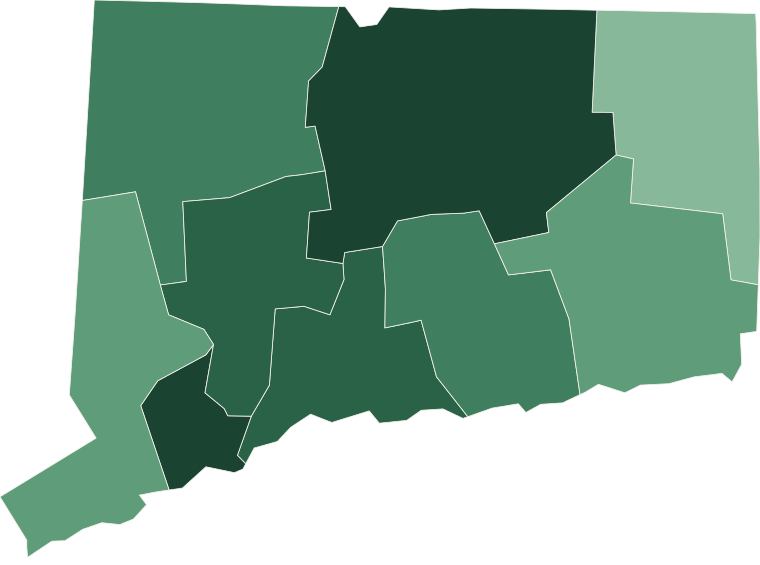
- under 1.42%
- 1.42% to 1.67%
- 1.67% to 1.88%
- 1.88% to 1.99%
- 1.99% and up
| County | Effective rate | Median yearly tax | Median home value |
|---|---|---|---|
| Capitol Planning Region | 1.99% | $6,454 | $323,700 |
| Greater Bridgeport Planning Region | 2.02% | $8,670 | $428,800 |
| Lower Connecticut River Valley Planning Region | 1.67% | $6,357 | $379,700 |
| Naugatuck Valley Planning Region | 1.88% | $5,983 | $317,700 |
| Northeastern Connecticut Planning Region | 1.42% | $4,375 | $307,600 |
| Northwest Hills Planning Region | 1.67% | $5,593 | $335,600 |
| South Central Connecticut Planning Region | 1.91% | $6,759 | $353,100 |
| Southeastern Connecticut Planning Region | 1.62% | $5,228 | $323,400 |
| Western Connecticut Planning Region | 1.42% | $9,295 | $652,900 |
Owner-occupied home data come from the Census American Community Survey 2020 through 2024. It reports median tax paid on real estate (table B25103) plus the median value (table B25077). Divide the median tax by the median value to get the effective rate. Download every county as a CSV file.
The Connecticut homestead exemption
Connecticut has no general homestead exemption. Across the state, no general homestead exemption or credit exists. Relief that does exist includes the circuit breaker credit for elderly and disabled people, veterans exemptions that apply by law, plus a state income tax credit for the property tax you paid, worth up to $300.
Reference: cga.ct.gov
Appealing a property tax assessment in Connecticut
APPEAL BYFebruary 20
Send a written appeal to the board of assessment appeals in your town by February 20. If the board's decision does not satisfy you, you can then take the case to superior court. Do so within two months from the date the board mailed its notice.
The first hearing goes before the local board of assessment appeals.
Reference: cga.ct.gov
When property tax payments are due in Connecticut
State law allows a one-month grace period once a tax payment falls due. A January 1 installment is on time through February 1. Past that date, interest starts accruing at 1.5% per month, and the minimum per installment is $2.
Reference: cga.ct.gov
Connecticut relief options for older homeowners
Homeowners throughout the state who are age 65 or older, or totally disabled, can get a property tax credit if their income falls under set limits. For married couples the credit reaches up to $1,250, and for single persons up to $1,000. It is applied to the tax bill. File the application with the assessor between February 1 and May 15.
Source: portal.ct.gov
Exemptions for disabled veterans in Connecticut
In every Connecticut town, veterans with a VA disability rating of 100% permanent and total must be fully exempt on their primary home. If no home is owned, one vehicle is exempt instead. This applies as of October 1, 2024. Every year, claimants file with the assessor no later than January 1.
Reference: cga.ct.gov
Help for homeowners with a disability
Meriden residents with a disability determination of 100% may seek a $1,000 exemption for real estate or a motor vehicle. You must file the documentation with the Assessor by January 31.
Details from meridenct.gov, a local office; what applies can differ from county to county.
How homes are valued in Connecticut
Property in Connecticut is assessed at 70% of the fair market value, according to a 2012 report by the state legislature's Office of Legislative Research. A $200,000 home would then carry a $140,000 assessed value.
Reference: cga.ct.gov
How yearly increases are limited
A town may let homeowners aged 70 or older freeze their property taxes if they have lived in Connecticut for at least a year. New applicants could no longer join the older state freeze; it closed in 1979.
Reference: cga.ct.gov
Other Connecticut property tax rules to know
- Under Meriden's tax deferral program, eligible owners may defer 50% of the tax due. A lien with annual interest of 7.75% is recorded for the deferral; it becomes payable upon transfer, sale, or death.
- Residents of Meriden who have total and permanent loss of sight may apply for a $3,000 exemption if a medical doctor certifies their condition. According to
Sources for these rules: meridenct.gov (a local office).
How Connecticut compares with other states
Use the property tax rates by state table to compare Connecticut's rate with every state, check homestead exemption eligibility elsewhere, or look up each state's appeal deadline.