
Rhode Island property tax calculator
Homeowners in Rhode Island pay a median of $4,900 each year, which is 1.21% of the median home value of $404,200.
This is an estimate, not a bill. Local taxing units set the rates, while your county assessor (called an appraisal district in some states) sets your value. Before you pay or protest, verify with your county.
Rates and typical bills for property tax in Rhode Island
At 0.94%, the US figure sits below the Rhode Island rate. County rates in the state range from 0.89% in Newport County to 1.35% in Kent County. The numbers are medians for owner-occupied homes, taken from Census American Community Survey 5-year estimates that cover 2020 to 2024.
Rhode Island: the yearly bill on common home values
| Home value | State median rate, 1.21% | Newport County, 0.89% | Kent County, 1.35% |
|---|---|---|---|
| $200,000 | $2,420 | $1,780 | $2,700 |
| $300,000 | $3,630 | $2,670 | $4,050 |
| $400,000 | $4,840 | $3,560 | $5,400 |
| $500,000 | $6,050 | $4,450 | $6,750 |
Multiply the home value by the effective rate. Kent County has the highest county rate in Rhode Island, and Newport County has the lowest; the calculator applies the rate for your own county.
Property tax rates by county in Rhode Island
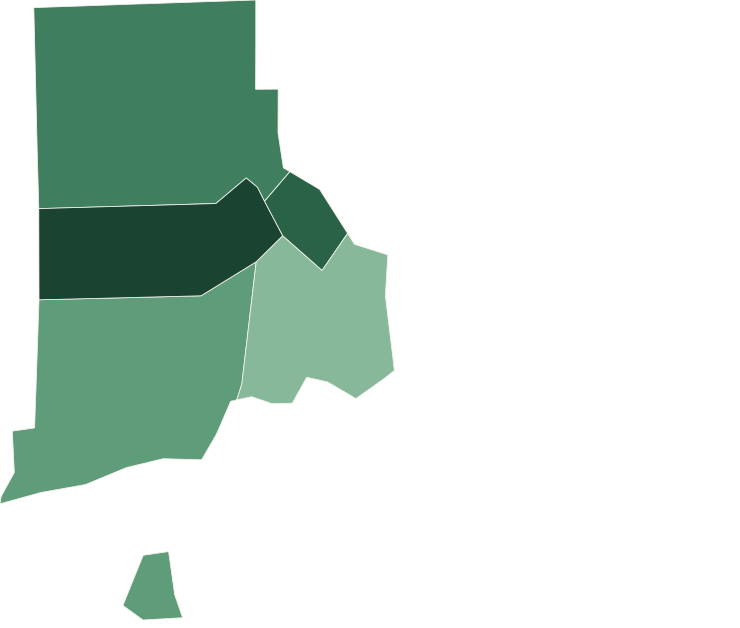
- under 1.00%
- 1.00% to 1.25%
- 1.25% to 1.29%
- 1.29% to 1.35%
- 1.35% and up
| County | Effective rate | Median yearly tax | Median home value |
|---|---|---|---|
| Bristol County | 1.29% | $6,648 | $513,800 |
| Kent County | 1.35% | $4,957 | $366,100 |
| Newport County | 0.89% | $5,414 | $609,700 |
| Providence County | 1.25% | $4,683 | $373,600 |
| Washington County | 1.00% | $5,102 | $510,800 |
Median real estate taxes paid come from table B25103, and median value from table B25077, for owner-occupied homes. The data are the Census American Community Survey 2020 to 2024. Divide the median tax by the median value to get the effective rate. Download all counties in a CSV file.
Homestead exemption in Rhode Island
Homestead exemption set locally (by town ordinance). Each town sets its own; Rhode Island has no homestead exemption that applies statewide. The General Assembly permits towns to adopt one by ordinance. South Kingstown's exemption was limited to 10 percent and covered residents living in the home.
Cited source: rilegislature.gov
Appealing a property tax assessment in Rhode Island
APPEAL BYWithin 30 days of the assessor's decision, or by January 31 if no decision comes
Submit the appeal to the local assessor's office, not to the state. If you are not satisfied with the assessor's decision, appeal to the tax board of review in your area within 30 days of that decision. January 31 is the deadline when the assessor issues no decision. You may petition Superior Court after that, within 30 days.
First hearing: Your city or town tax assessor hears the appeal first. If the outcome still leaves you dissatisfied, the local tax board of review handles the next step.
Cited source: municipalfinance.ri.gov
Property tax due dates in Rhode Island
Statewide dates apply to just one tax, the Non-Owner Occupied Property Tax (homes that are not the owner's main residence and are assessed over $1 million). You pay four equal installments due September 15, December 15, March 15 and June 15, or a single lump sum paid by September 15.
Cited source: tax.ri.gov
Help for older homeowners in Rhode Island
Each town sets its own rules, so senior relief differs by community. Exemptions or credits for owners at age 65 or older are typical, and the programs set income limits along with residency or ownership requirements. One town offers a flat exemption of $5,000 for people age 65+ or who are 100% disabled.
Cited source: municipalfinance.ri.gov
Exemptions for disabled veterans in Rhode Island
Each town sets this under state law. A city or town that passes an ordinance may give veterans who are totally disabled through a service-connected disability a $10,000 exemption. Some towns set higher amounts. File your application with the town tax assessor.
See webserver.rilegislature.gov for the source
Relief for homeowners who have a disability
Providence's Social Security Disability Exemption is $499. Homeowners who are 100% disabled under titles II and XVI of the Social Security Act can get it.
providenceri.gov is a local office source, and its rule can differ by county.
How your home is valued in Rhode Island
The assessed value of residential property is set by each city or town as of December 31. For its non-owner occupied property tax, the state Division of Taxation relies on the value set locally.
See tax.ri.gov for the source
Other property tax rules in Rhode Island that are worth knowing
- Homestead exemptions are not offered in Cranston. You must apply in person at the Assessor's office, room 113, for its other exemptions and tax freeze.
- Applications for Cranston's exemption and tax freeze must arrive by March 15 to apply to the current year's bill. Neither exceptions nor retroactive relief are allowed.
- In Lincoln, the homestead exemption covers owner-occupied residences with up to five units. For it to take effect that year, you must apply by April 15. If you do not, it applies the following year.
- Homeowners in Providence who qualify as legally blind under federal standards can receive a $921 Blind Exemption. Certification must come from a licensed physician or from Rhode Island services for blind and visually impaired people.
Sources for these rules: cranstonri.gov; lincolnri.gov; providenceri.gov (a local office).
Compare other states with Rhode Island
Check the property tax rates by state table to see how the Rhode Island rate ranks among all states, find out who qualifies for a homestead exemption in other states, or look up the appeal deadline for each state.