
West Virginia property tax calculator
In West Virginia, the median yearly payment from homeowners is $865. This amount equals 0.53% of the median home value, $162,600.
This is an estimate, not a bill. Your county assessor (or an appraisal district in some states) sets your value, while your local taxing units set the rates. Before you pay or protest, check with your county.
Typical bill and property tax rate in West Virginia
West Virginia's rate falls below the US figure of 0.94%. County rates across the state range from 0.30% in Pocahontas County to 0.67% in McDowell County. The numbers are median figures for owner-occupied homes, taken from the Census American Community Survey 5-year estimates covering 2020 to 2024.
Yearly taxes for typical home values in West Virginia
| Home value | State median rate, 0.53% | Pocahontas County, 0.30% | McDowell County, 0.67% |
|---|---|---|---|
| $200,000 | $1,060 | $600 | $1,340 |
| $300,000 | $1,590 | $900 | $2,010 |
| $400,000 | $2,120 | $1,200 | $2,680 |
| $500,000 | $2,650 | $1,500 | $3,350 |
Multiply the home value by the effective rate. Of all West Virginia counties, Pocahontas County has the lowest rate and McDowell County the highest; the calculator applies the rate from your own county.
Property tax rates for each West Virginia county
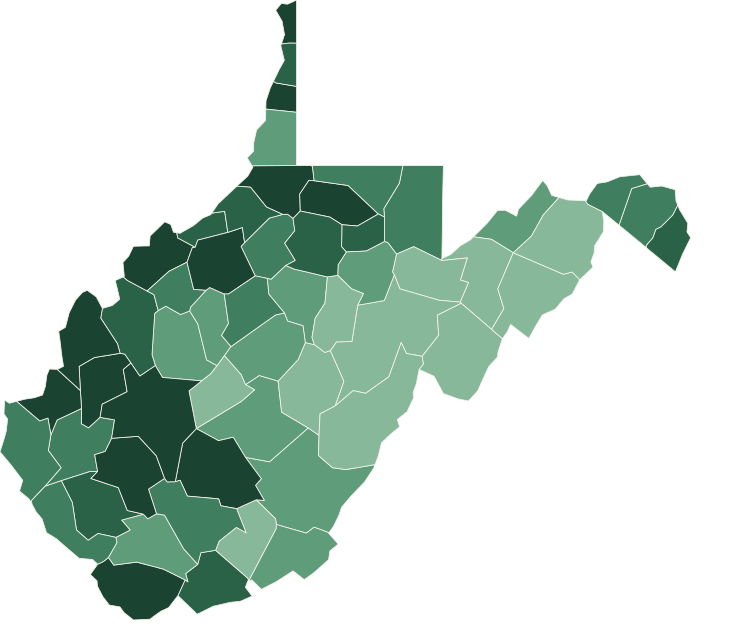
- below 0.42%
- 0.42% through 0.47%
- 0.47% to 0.53%
- 0.53% to 0.59%
- 0.59% and above
The highest rates found in West Virginia
| County | Effective rate | Median yearly tax |
|---|---|---|
| McDowell County | 0.67% | $337 |
| Wetzel County | 0.67% | $721 |
| Boone County | 0.67% | $620 |
| Ritchie County | 0.66% | $763 |
| Kanawha County | 0.65% | $964 |
The lowest rates found in West Virginia
| County | Effective rate | Median yearly tax |
|---|---|---|
| Pocahontas County | 0.30% | $462 |
| Grant County | 0.31% | $540 |
| Summers County | 0.31% | $439 |
| Pendleton County | 0.34% | $633 |
| Hardy County | 0.35% | $575 |
A to Z list of all 55 West Virginia counties
| County | Effective rate | Median yearly tax | Median home value |
|---|---|---|---|
| Barbour County | 0.43% | $562 | $131,900 |
| Berkeley County | 0.53% | $1,398 | $266,300 |
| Boone County | 0.67% | $620 | $93,100 |
| Braxton County | 0.45% | $535 | $117,900 |
| Brooke County | 0.53% | $746 | $141,500 |
| Cabell County | 0.60% | $992 | $164,400 |
| Calhoun County | 0.42% | $426 | $100,500 |
| Clay County | 0.35% | $377 | $109,100 |
| Doddridge County | 0.50% | $808 | $160,800 |
| Fayette County | 0.64% | $676 | $105,800 |
| Gilmer County | 0.49% | $410 | $83,800 |
| Grant County | 0.31% | $540 | $175,100 |
| Greenbrier County | 0.45% | $663 | $149,000 |
| Hampshire County | 0.38% | $836 | $219,200 |
| Hancock County | 0.63% | $826 | $130,800 |
| Hardy County | 0.35% | $575 | $166,300 |
| Harrison County | 0.55% | $908 | $166,200 |
| Jackson County | 0.53% | $834 | $157,200 |
| Jefferson County | 0.53% | $1,857 | $350,800 |
| Kanawha County | 0.65% | $964 | $147,300 |
| Lewis County | 0.46% | $692 | $151,800 |
| Lincoln County | 0.51% | $538 | $105,300 |
| Logan County | 0.56% | $576 | $103,400 |
| Marion County | 0.59% | $978 | $166,700 |
| Marshall County | 0.45% | $680 | $149,800 |
| Mason County | 0.59% | $706 | $120,300 |
| McDowell County | 0.67% | $337 | $50,000 |
| Mercer County | 0.54% | $656 | $121,700 |
| Mineral County | 0.45% | $818 | $180,400 |
| Mingo County | 0.47% | $423 | $90,500 |
| Monongalia County | 0.47% | $1,248 | $267,700 |
| Monroe County | 0.46% | $725 | $156,300 |
| Morgan County | 0.47% | $1,125 | $240,600 |
| Nicholas County | 0.46% | $554 | $121,600 |
| Ohio County | 0.60% | $999 | $166,000 |
| Pendleton County | 0.34% | $633 | $183,800 |
| Pleasants County | 0.54% | $819 | $151,000 |
| Pocahontas County | 0.30% | $462 | $152,400 |
| Preston County | 0.49% | $793 | $162,800 |
| Putnam County | 0.59% | $1,311 | $223,300 |
| Raleigh County | 0.50% | $754 | $150,900 |
| Randolph County | 0.39% | $559 | $144,800 |
| Ritchie County | 0.66% | $763 | $115,900 |
| Roane County | 0.44% | $537 | $122,100 |
| Summers County | 0.31% | $439 | $140,100 |
| Taylor County | 0.54% | $797 | $148,800 |
| Tucker County | 0.37% | $575 | $154,800 |
| Tyler County | 0.57% | $689 | $121,300 |
| Upshur County | 0.42% | $717 | $170,800 |
| Wayne County | 0.47% | $594 | $127,100 |
| Webster County | 0.40% | $303 | $76,100 |
| Wetzel County | 0.67% | $721 | $107,900 |
| Wirt County | 0.52% | $597 | $115,800 |
| Wood County | 0.59% | $941 | $158,500 |
| Wyoming County | 0.45% | $369 | $82,900 |
For owner-occupied homes, table B25103 gives median real estate taxes paid, and table B25077 gives median values. Census American Community Survey 2020 to 2024. To find the effective rate, divide the median tax by the median value. Download all counties in a CSV file.
Homestead exemption in West Virginia
Homestead Property Tax Exemption: a $20,000 homestead exemption Ad valorem property tax does not apply to the first $20,000 of an owner-occupied home's assessed value. To qualify, the owner must either be 65 or older or hold certification of permanent and total disability, and must meet the state residency rule.
See the source at code.wvlegislature.gov
Contesting a property tax assessment in West Virginia: the process
APPEAL BYFile your protest during the board session from February 1 to February 28. An Office of Tax Appeals petition is due by March 31
Send your county commission a protest of the assessed value. The commission serves as the board of equalization and review. The board begins meeting February 1 and is required to adjourn by February 28. Any further appeal must go to the Office of Tax Appeals, and you must file it by March 31.
The County commission serves as the Board of Equalization and Review at the first hearing.
See the source at tax.wv.gov
Property tax due dates in West Virginia
Across the state, property taxes are paid in two installments, with September 1 and March 1 due dates. First-half taxes that remain unpaid become delinquent October 1, and second-half taxes that remain unpaid become delinquent April 1. Pay early and you receive a 2.5 percent discount.
See the source at tax.wv.gov
West Virginia relief for older homeowners
If you are 65 or older, property tax does not apply to the first $20,000 of the assessed value of your owner-occupied residence.
See the source at tax.wv.gov
West Virginia exemption for disabled veterans
Veterans in West Virginia may receive the Disabled Veteran Real Property Tax Credit. To qualify, they must have been honorably discharged, own a residential homestead, and be rated 90-100% permanently and totally disabled. You claim it using form DV-1 when you file your state income tax return. Property taxes must be paid on time.
See the source at tax.wv.gov
How your home is valued in West Virginia
For taxation, homes generally receive an assessed value equal to 60 percent of fair market value; a $100,000 home, for example, is assessed at $60,000. Your county assessor sets residential real estate values.
Source: tax.wv.gov
Other West Virginia property tax rules to know
- You may also file a valuation appeal with the state Office of Tax Appeals. If you appeal a valuation or a county Board of Equalization order, file the petition by March 31 for the property tax year, or it will be dismissed.
- You may appeal a decision by the county's Board of Equalization and Review to the circuit court. The deadline is 30 calendar days after the decision's postmark date.
- An increase of 10% or more, or $1,000 or more, over the prior year in a home's assessed value leads the assessor to send a Change of Value Notice. Its due date falls on January 15 in the property tax year.
- An owner qualifies for the homestead exemption only if the owner has lived, or will live, as a resident of West Virginia for two calendar years in a row before the tax year. You cannot qualify if you get a similar exemption in another state.
Rule sources: code.wvlegislature.gov; a local office, putnamcountywv.gov; code.wvlegislature.gov.
How West Virginia compares with other states
The state property tax rate table shows where the West Virginia rate ranks among every state. You can also check homestead exemption qualifications in other states or find the state appeal deadlines.