
Illinois property tax calculator
Illinois homeowners pay $5,298 each year at the median. That amount equals 2.01% of the median home value, $263,300.
This is an estimate, not a bill. Your county assessor, or appraisal district in some states, sets your value; local taxing units set the rates. Before paying or filing a protest, check with your county.
Property tax rate and typical bill in Illinois
Illinois has a higher rate than the US figure of 0.94%. County rates across Illinois range from 0.96% in Hardin County to 2.58% in Lake County. For owner-occupied homes, the figures are medians from the Census American Community Survey 5-year estimates for 2020 to 2024.
Annual bills for common Illinois home values
| Home value | State median rate, 2.01% | Hardin County, 0.96% | Lake County, 2.58% |
|---|---|---|---|
| $200,000 | $4,020 | $1,920 | $5,160 |
| $300,000 | $6,030 | $2,880 | $7,740 |
| $400,000 | $8,040 | $3,840 | $10,320 |
| $500,000 | $10,050 | $4,800 | $12,900 |
Multiply the home value by the effective rate. Hardin County has Illinois's lowest county rate, while Lake County has the highest; your county's rate is used in the calculator.
Property tax rates by Illinois county
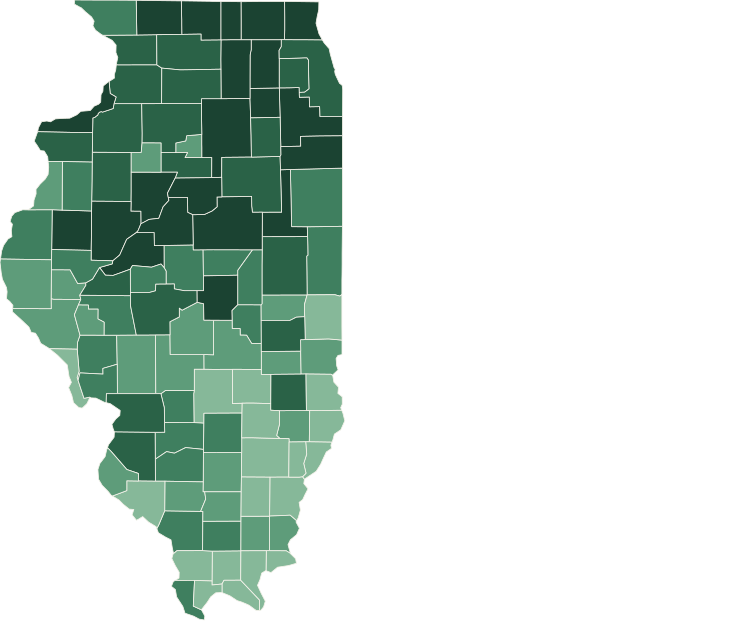
- under 1.50%
- 1.50% to 1.71%
- 1.71% to 1.91%
- 1.91% to 2.09%
- 2.09% and up
Illinois's highest rates
| County | Effective rate | Median yearly tax |
|---|---|---|
| Lake County | 2.58% | $8,923 |
| DeKalb County | 2.45% | $5,974 |
| Stephenson County | 2.40% | $3,240 |
| Winnebago County | 2.39% | $3,930 |
| Kendall County | 2.37% | $7,651 |
Illinois's lowest rates
| County | Effective rate | Median yearly tax |
|---|---|---|
| Hardin County | 0.96% | $1,001 |
| Pulaski County | 1.02% | $869 |
| Pope County | 1.03% | $1,477 |
| Lawrence County | 1.19% | $1,174 |
| Johnson County | 1.24% | $1,992 |
All 102 Illinois counties, listed from A to Z
| County | Effective rate | Median yearly tax | Median home value |
|---|---|---|---|
| Adams County | 1.58% | $2,573 | $162,600 |
| Alexander County | 1.81% | $1,084 | $59,800 |
| Bond County | 1.89% | $2,747 | $145,700 |
| Boone County | 2.18% | $4,735 | $216,900 |
| Brown County | 1.52% | $2,291 | $150,300 |
| Bureau County | 2.01% | $2,548 | $126,900 |
| Calhoun County | 1.39% | $2,644 | $190,900 |
| Carroll County | 1.99% | $2,277 | $114,500 |
| Cass County | 2.02% | $1,958 | $97,100 |
| Champaign County | 2.06% | $4,353 | $211,500 |
| Christian County | 1.64% | $1,891 | $115,500 |
| Clark County | 1.56% | $2,064 | $132,400 |
| Clay County | 1.43% | $1,392 | $97,400 |
| Clinton County | 1.83% | $3,524 | $192,400 |
| Coles County | 1.94% | $2,474 | $127,400 |
| Cook County | 1.91% | $6,191 | $324,500 |
| Crawford County | 1.49% | $1,806 | $121,100 |
| Cumberland County | 1.59% | $2,004 | $126,000 |
| De Witt County | 1.78% | $2,322 | $130,300 |
| DeKalb County | 2.45% | $5,974 | $243,600 |
| Douglas County | 1.70% | $2,554 | $150,400 |
| DuPage County | 2.05% | $8,007 | $391,400 |
| Edgar County | 1.45% | $1,409 | $97,300 |
| Edwards County | 1.45% | $1,451 | $100,000 |
| Effingham County | 1.49% | $2,823 | $189,500 |
| Fayette County | 1.45% | $1,894 | $130,700 |
| Ford County | 2.12% | $2,587 | $122,000 |
| Franklin County | 1.57% | $1,394 | $89,000 |
| Fulton County | 2.13% | $2,289 | $107,200 |
| Gallatin County | 1.57% | $1,305 | $82,900 |
| Greene County | 1.75% | $1,661 | $95,200 |
| Grundy County | 2.00% | $5,420 | $271,700 |
| Hamilton County | 1.33% | $1,512 | $113,700 |
| Hancock County | 1.81% | $2,059 | $113,800 |
| Hardin County | 0.96% | $1,001 | $103,800 |
| Henderson County | 1.58% | $1,651 | $104,400 |
| Henry County | 1.99% | $3,016 | $151,600 |
| Iroquois County | 1.82% | $2,504 | $137,800 |
| Jackson County | 1.84% | $2,526 | $137,300 |
| Jasper County | 1.95% | $2,448 | $125,500 |
| Jefferson County | 1.71% | $2,148 | $126,000 |
| Jersey County | 1.76% | $3,020 | $171,900 |
| Jo Daviess County | 1.72% | $3,613 | $209,900 |
| Johnson County | 1.24% | $1,992 | $160,500 |
| Kane County | 2.26% | $7,382 | $327,000 |
| Kankakee County | 2.21% | $4,266 | $192,600 |
| Kendall County | 2.37% | $7,651 | $322,400 |
| Knox County | 1.96% | $2,190 | $111,900 |
| LaSalle County | 2.11% | $3,418 | $161,900 |
| Lake County | 2.58% | $8,923 | $345,700 |
| Lawrence County | 1.19% | $1,174 | $99,100 |
| Lee County | 1.97% | $3,048 | $154,600 |
| Livingston County | 2.04% | $2,908 | $142,200 |
| Logan County | 1.77% | $2,385 | $134,400 |
| Macon County | 2.12% | $2,696 | $127,300 |
| Macoupin County | 1.50% | $2,073 | $138,200 |
| Madison County | 1.92% | $3,319 | $173,000 |
| Marion County | 1.71% | $1,759 | $103,000 |
| Marshall County | 1.94% | $2,766 | $142,800 |
| Mason County | 2.09% | $2,162 | $103,400 |
| Massac County | 1.40% | $1,704 | $121,900 |
| McDonough County | 2.13% | $2,285 | $107,500 |
| McHenry County | 2.36% | $7,274 | $308,100 |
| McLean County | 2.17% | $4,524 | $208,400 |
| Menard County | 1.72% | $3,190 | $185,500 |
| Mercer County | 1.96% | $2,878 | $146,700 |
| Monroe County | 1.63% | $4,588 | $282,100 |
| Montgomery County | 1.68% | $1,887 | $112,300 |
| Morgan County | 1.76% | $2,306 | $130,800 |
| Moultrie County | 1.80% | $2,414 | $134,000 |
| Ogle County | 2.06% | $3,889 | $189,200 |
| Peoria County | 2.24% | $3,552 | $158,500 |
| Perry County | 1.60% | $1,807 | $112,600 |
| Piatt County | 1.81% | $3,265 | $180,600 |
| Pike County | 1.53% | $1,556 | $101,400 |
| Pope County | 1.03% | $1,477 | $143,800 |
| Pulaski County | 1.02% | $869 | $85,100 |
| Putnam County | 1.57% | $2,705 | $172,700 |
| Randolph County | 1.43% | $1,927 | $135,100 |
| Richland County | 1.58% | $1,769 | $112,000 |
| Rock Island County | 2.28% | $3,425 | $150,400 |
| Saline County | 1.69% | $1,597 | $94,300 |
| Sangamon County | 1.99% | $3,512 | $176,300 |
| Schuyler County | 1.78% | $1,950 | $109,700 |
| Scott County | 1.50% | $1,446 | $96,400 |
| Shelby County | 1.50% | $2,063 | $137,100 |
| St. Clair County | 2.03% | $3,665 | $180,300 |
| Stark County | 1.69% | $1,768 | $104,500 |
| Stephenson County | 2.40% | $3,240 | $134,900 |
| Tazewell County | 2.11% | $3,536 | $167,500 |
| Union County | 1.30% | $1,712 | $131,700 |
| Vermilion County | 1.81% | $1,757 | $97,200 |
| Wabash County | 1.41% | $1,475 | $104,900 |
| Warren County | 1.81% | $1,903 | $105,000 |
| Washington County | 1.87% | $2,908 | $155,700 |
| Wayne County | 1.49% | $1,653 | $110,700 |
| White County | 1.34% | $1,444 | $108,100 |
| Whiteside County | 2.04% | $2,598 | $127,100 |
| Will County | 2.24% | $7,173 | $319,600 |
| Williamson County | 1.72% | $2,690 | $156,400 |
| Winnebago County | 2.39% | $3,930 | $164,500 |
| Woodford County | 2.13% | $4,215 | $197,600 |
Median real estate taxes paid, from table B25103, and median value, from table B25077, for owner-occupied homes, based on Census American Community Survey 2020 to 2024 data. Divide the median tax by the median value to calculate the effective rate. Download every county as a CSV file.
The Illinois homestead exemption
The General Homestead Exemption is called the Homeowner Exemption in Cook County. Cook County allows owner-occupied principal residences an equalized assessed value reduction of up to $10,000. Counties next to Cook allow $8,000, including Kane's current $8,000 reduction, while other counties allow $6,000.
Apply in Cook County online, or get a form from either the Assessor's Office or the township assessor. After approval, it renews on its own. In Kane County, file through the County Assessment Office using its online portal or a phone call.
Cook County's regular filing window for tax year 2025 has already closed. Applications filed late are handled through Certificates of Error.
Information from tax.illinois.gov
Steps for appealing an Illinois property tax assessment
APPEAL BYEach county board of review sets its own deadline; for the state appeal board, the period is 30 days following the board's written decision
Appeal the assessed value rather than the tax bill. Discuss the assessment informally with the assessor first, then send a written complaint to the county board of review. Each board determines its own filing deadline and required forms. A later appeal goes to the state-level Property Tax Appeal Board and is due within 30 days after the board decides.
First hearing: the County board of review. Cook County uses the County Assessor or, alternatively, the Board of Review.
Source: tax.illinois.gov
Due dates for Illinois property taxes
Under Illinois law, the first installment is delinquent if unpaid by whichever comes later: June 1 or the day following the bill's due date. The second installment works the same way with September 1.
Source: ilga.gov
Help for older homeowners in Illinois
This is a deferral, not a reduction. When household income is up to $77,000 for the 2026 tax year, homeowners who reach 65 by June 1 can defer up to $7,500 per year at 3% interest. File with the county collector every year.
Source: tax.illinois.gov
Exemption for disabled veterans in Illinois
The Standard Homestead Exemption for Veterans with Disabilities provides different EAV reductions by service-connected disability rating. Veterans rated 30% to under 50% receive $2,500, those rated 50% to under 70% receive $5,000, and those rated 70% or more have the first $250,000 exempt.
Information from tax.illinois.gov
Help for homeowners with a disability
An annual $2,000 EAV reduction applies to the primary residence of homeowners with a disability. Proof of disability must accompany Form PTAX-343, while yearly renewal uses Form PTAX-343-R.
Information from tax.illinois.gov
How Illinois determines your home's value
For a home outside Cook County, the assessment equals 33 1/3 percent of the fair market value. That value is measured as of January 1 in the tax year. Homes in Cook County carry a 10 percent assessment. Township or county assessors set these values, and each property is reassessed on a four-year cycle (three years in Cook).
Information from tax.illinois.gov
Yearly increase limits
Illinois does not cap an individual home's assessment or bill. For non-home rule districts, the PTELL limits yearly growth in the total amount of taxes billed to inflation plus new construction.
Source information: tax.illinois.gov.
Other property tax rules in Illinois to know
- A $5,000 EAV reduction applies to the principal residence of a veteran returning from an armed conflict after active duty, for two consecutive tax years. Use Form PTAX-341.
- Under the Homestead Improvement Exemption, qualifying improvements receive a reduction covering up to $75,000 in fair cash value, or $25,000 in assessed value. The exemption lasts four years from completion and occupancy.
- Veterans with disabilities living in federally funded, specially adapted housing may get an assessed value reduction of up to $100,000. The benefit continues for as long as the veteran, spouse, or unmarried surviving spouse occupies the home.
- Homeowners in Cook County who did not file during the 2025 filing period for the Homeowner Exemption can still redeem the exemption they missed. Submit a Certificate of Error either online or on paper through
Sources for these rules: tax.illinois.gov; cookcountyassessoril.gov (a local office).
How Illinois compares with other states
Check the state property tax table to see where Illinois ranks among all states, find homestead exemption eligibility elsewhere, or check each state's appeal deadline.