
Vermont property tax calculator
The median yearly bill for Vermont homeowners is $5,039, which equals 1.59% of $316,600, the median home value.
This is an estimate, not a bill. Your county assessor (or an appraisal district in some states) sets your value, while your local taxing units set the rates. Check with your county before paying or protesting.
Typical Vermont property tax bills and rates
At 0.94%, the US figure is lower than the Vermont rate. County rates across the state range from 1.32% in Grand Isle County to 1.84% in Windsor County. The numbers are medians for owner-occupied homes, based on the Census American Community Survey 5-year estimates covering 2020 to 2024.
Annual taxes for typical home values in Vermont
| Home value | State median rate, 1.59% | Grand Isle County, 1.32% | Windsor County, 1.84% |
|---|---|---|---|
| $200,000 | $3,180 | $2,640 | $3,680 |
| $300,000 | $4,770 | $3,960 | $5,520 |
| $400,000 | $6,360 | $5,280 | $7,360 |
| $500,000 | $7,950 | $6,600 | $9,200 |
Multiply the home value by the effective rate. Among Vermont counties, Grand Isle County has the lowest rate, while Windsor County has the highest. The calculator applies the rate for your own county.
Property tax rates for each Vermont county
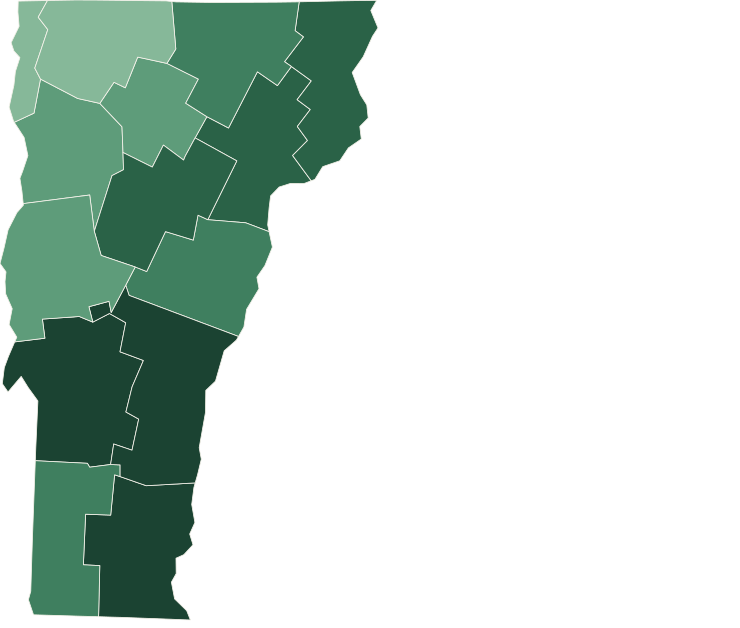
- under 1.51%
- 1.51% to 1.64%
- 1.64% to 1.75%
- 1.75% to 1.81%
- 1.81% and up
| County | Effective rate | Median yearly tax | Median home value |
|---|---|---|---|
| Addison County | 1.57% | $5,690 | $361,200 |
| Bennington County | 1.64% | $4,580 | $279,900 |
| Caledonia County | 1.76% | $4,022 | $227,900 |
| Chittenden County | 1.51% | $6,617 | $439,200 |
| Essex County | 1.76% | $3,035 | $172,500 |
| Franklin County | 1.41% | $4,332 | $306,700 |
| Grand Isle County | 1.32% | $5,195 | $394,100 |
| Lamoille County | 1.57% | $4,785 | $304,700 |
| Orange County | 1.67% | $4,516 | $271,300 |
| Orleans County | 1.65% | $3,692 | $223,400 |
| Rutland County | 1.81% | $4,154 | $229,400 |
| Washington County | 1.75% | $5,498 | $315,000 |
| Windham County | 1.81% | $5,062 | $279,600 |
| Windsor County | 1.84% | $5,458 | $296,400 |
Based on owner-occupied homes, the medians for real estate taxes paid (table B25103) and home value (table B25077) come from Census American Community Survey 2020 to 2024. Dividing the median tax by the median value gives you the effective rate. Download every county as CSV.
Homestead tax exemption in Vermont
Homestead Declaration. Every year, owners must declare their home a homestead if they live there as their domicile on April 1, 2026. Without that declaration, the home is taxed as nonhomestead, and each category has a different education property tax rate.
How to apply: Submit Form HS-122 online through myVTax or on paper. It covers the Homestead Declaration and the Property Tax Credit Claim, and the form must be signed on the back.
Submit by April 15, 2026; the final date accepted is October 15, 2026.
Source: see tax.vermont.gov.
How to appeal a property tax assessment in Vermont
APPEAL BY14 days after that Result of Grievance decision is mailed
The town Board of Civil Authority hears appeals from homeowners who dispute the town lister's grievance decision about the home's value. File the appeal within 14 days of the mailing of the Result of Grievance decision.
The Board of Civil Authority (BCA) holds the first hearing, following the town listers' grievance decision.
Source: see tax.vermont.gov.
Due dates for Vermont property taxes
Each town sets its own dates; no single due date applies statewide. Each town mails one bill yearly, usually 30 days ahead of its due date, and may split payment into yearly, twice-yearly, or quarterly installments. Ask your town about its dates.
Source: tax.vermont.gov
Help for older homeowners in Vermont
Eligible homestead owners get help from the statewide Property Tax Credit, which lists no age requirement. For education tax, the credit reaches a maximum of $5,600, and for municipal tax it reaches $2,400. Household income for tax year 2025 cannot exceed $115,400.
Source: see tax.vermont.gov.
Exemption for disabled veterans in Vermont
Under Vermont law, certain surviving spouses and eligible disabled veterans, including veterans rated 50% or higher, receive a property tax exemption for their primary home. The minimum exemption is $10,000, though towns may raise that amount to $40,000.
Source: see veterans.vermont.gov.
How does Vermont value your home?
Property taxes in Vermont are mostly handled and assessed by individual cities or towns. Support for local listers and assessors comes from the state Division of Property Valuation and Review.
Source: see tax.vermont.gov.
Additional Vermont property tax rules to know
- Through the Vermont Property Tax Credit, the state education part of a qualifying homestead owner's bill can be reduced by up to $5,600, and the municipal part by up to $2,400. A household income limit applies.
- Filing by the extended October 15 date for your Homestead Declaration lets you claim the Property Tax Credit through March 15 the following year. A processing fee of $150 is deducted.
- A property is classified as nonhomestead if its owner misses the October deadline for filing the Homestead Declaration. After that, the owner pays whichever education rate is higher, along with a penalty and any extra tax and interest.
- You must appeal in writing any dispute with the state Department of Taxes, including a denied or reduced property tax credit. The request must arrive within 60 days after the notice is mailed.
Sources for these rules: tax.vermont.gov; tax.vermont.gov; tax.vermont.gov.
How Vermont compares with other states
See where Vermont's rate falls among all states in the state property tax rates table, check homestead exemption eligibility elsewhere, or look up appeal deadlines in each state.