
Utah property tax calculator
The median annual tax for Utah homeowners is $2,525, worked out at 0.52% of the median home value of $489,400.
This is an estimate, not a bill. Your value is set by your county assessor (an appraisal district in some states), and the rates come from your local taxing units. Check with your county first, before you pay or protest.
Typical bill and property tax rate in Utah
In Utah the rate sits under the US figure of 0.94%. County rates in the state range from 0.26% in Rich County to 0.80% in San Juan County. These are median figures for owner-occupied homes, drawn from the Census American Community Survey 5-year estimates covering 2020 to 2024.
Yearly tax bills for typical Utah home values
| Home value | State median rate, 0.52% | Rich County, 0.26% | San Juan County, 0.80% |
|---|---|---|---|
| $200,000 | $1,040 | $520 | $1,600 |
| $300,000 | $1,560 | $780 | $2,400 |
| $400,000 | $2,080 | $1,040 | $3,200 |
| $500,000 | $2,600 | $1,300 | $4,000 |
Multiply the home value by the effective rate. In Utah, the lowest county rate belongs to Rich County and the highest to San Juan County. The calculator uses the rate for your own county.
Property tax rates in each Utah county
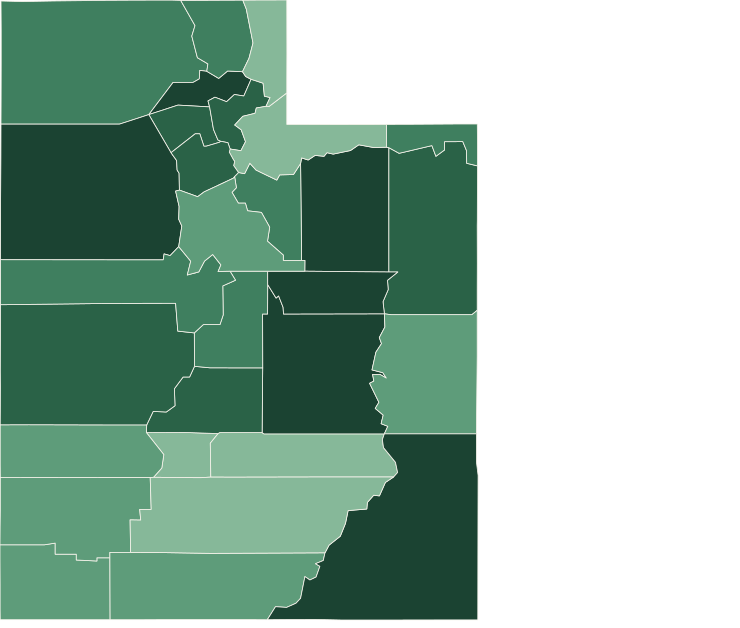
- under 0.40%
- 0.40% to 0.45%
- 0.45% to 0.51%
- 0.51% to 0.57%
- 0.57% and up
Utah's highest rates
| County | Effective rate | Median yearly tax |
|---|---|---|
| San Juan County | 0.80% | $1,788 |
| Emery County | 0.62% | $1,350 |
| Duchesne County | 0.61% | $1,742 |
| Carbon County | 0.61% | $1,394 |
| Weber County | 0.60% | $2,557 |
Utah's lowest rates
| County | Effective rate | Median yearly tax |
|---|---|---|
| Rich County | 0.26% | $859 |
| Wayne County | 0.34% | $1,394 |
| Summit County | 0.35% | $3,701 |
| Garfield County | 0.35% | $1,127 |
| Piute County | 0.35% | $939 |
Every Utah county, all 29 from A to Z
| County | Effective rate | Median yearly tax | Median home value |
|---|---|---|---|
| Beaver County | 0.40% | $1,142 | $283,700 |
| Box Elder County | 0.49% | $1,966 | $403,600 |
| Cache County | 0.45% | $2,011 | $444,400 |
| Carbon County | 0.61% | $1,394 | $228,500 |
| Daggett County | 0.46% | $1,304 | $282,300 |
| Davis County | 0.53% | $2,665 | $505,500 |
| Duchesne County | 0.61% | $1,742 | $283,700 |
| Emery County | 0.62% | $1,350 | $218,700 |
| Garfield County | 0.35% | $1,127 | $318,100 |
| Grand County | 0.41% | $2,215 | $538,700 |
| Iron County | 0.41% | $1,558 | $379,000 |
| Juab County | 0.45% | $1,914 | $425,400 |
| Kane County | 0.40% | $1,630 | $410,900 |
| Millard County | 0.51% | $1,454 | $284,700 |
| Morgan County | 0.52% | $3,411 | $654,900 |
| Piute County | 0.35% | $939 | $264,800 |
| Rich County | 0.26% | $859 | $334,600 |
| Salt Lake County | 0.54% | $2,836 | $525,700 |
| San Juan County | 0.80% | $1,788 | $224,200 |
| Sanpete County | 0.47% | $1,619 | $347,200 |
| Sevier County | 0.54% | $1,683 | $311,200 |
| Summit County | 0.35% | $3,701 | $1,067,700 |
| Tooele County | 0.57% | $2,460 | $431,600 |
| Uintah County | 0.51% | $1,523 | $298,600 |
| Utah County | 0.44% | $2,370 | $538,700 |
| Wasatch County | 0.46% | $3,624 | $787,300 |
| Washington County | 0.42% | $2,158 | $510,700 |
| Wayne County | 0.34% | $1,394 | $411,800 |
| Weber County | 0.60% | $2,557 | $426,700 |
Table B25103 gives the median real estate taxes paid and table B25077 the median value, for owner-occupied homes in the Census American Community Survey 2020 to 2024. To find the effective rate, divide the median tax by the median value. Download all counties as a CSV file.
Homestead exemption in Utah
The Primary Residential Property Exemption (a 45% residential exemption). A qualifying primary residence receives a 45% exemption, which leaves taxable value at 55% of market value. For at least 183 consecutive days each year, the property must serve as someone's primary domicile, and Utah permits only one exemption per household.
To apply, submit Form TC-473A to the County Board of Equalization. If the home is still under construction, submit Form PT-24 instead. Starting January 1, 2027, 2026 SB 238 requires this after a change of ownership, after a prior year of ineligibility, or after a county review.
Filing deadline: September 15. The County Board of Equalization cannot accept late applications.
Information from: tax.utah.gov
Appealing a Utah property tax assessment
APPEAL BYGenerally: September 15
The first appeal for homeowners goes to the County Board of Equalization over their property value, and that group issues a written decision. Generally, the deadline is September 15. Within 30 days, you can appeal that decision to the Utah State Tax Commission.
First hearing: the County Board of Equalization for the county in which the property sits.
Information from: tax.utah.gov
Utah property tax due dates
Each year, property taxes are due November 30. If that date lands on a weekend or a holiday, the next working day applies. Any taxes you pay or postmark after the due date count as delinquent.
Information from: le.utah.gov
Utah help for older homeowners
Under Utah's Mandatory Senior Deferral Program, homeowners aged 75 or older can defer property taxes on their single-family primary residence. Eligibility includes 2025 household income of no more than $88,442, plus other conditions.
Information from: tax.utah.gov
Utah exemption for disabled veterans
Veterans whose service-connected disability is at least 10 percent, along with their unmarried surviving spouses and their minor orphans, may receive a property tax exemption covering up to $535,459 of a residence's taxable value, depending on disability percentage.
The source for this is tax.utah.gov
How your Utah home gets valued
Every year, County assessors list and value all property at 100% of fair market value, following rules set by the Tax Commission. A primary residence has its taxable value reduced by 45% under Utah's Constitution.
Information from: kane.utah.gov
Other Utah property tax rules to know
- Missing the September 15 filing deadline can mean losing the exemption for that tax year. Tax on the property would then apply at 100% of market value.
- If a tenant occupies your rental home as a primary residence, you as the owner must sign a residential declaration. A lease or tax schedule may be requested by the assessor, though contacting the tenants is not permitted.
- A mailed residential declaration left incomplete within 30 days of the mailing date leads Salt Lake County to remove the exemption. Then the owner must reapply, supplying supporting evidence.
- If you claim the residential exemption for a home in Utah, you are presumed to be domiciled in Utah for income tax purposes.
Sources for these rules: tax.utah.gov; saltlakecounty.gov (a local office); webercountyutah.gov (a local office).
Utah compared with other states
Check the property tax rates by state table to see where the Utah rate ranks, find out who qualifies for a homestead exemption in other states, or look up the appeal deadline for each state.