
New Hampshire property tax calculator
The median yearly payment for New Hampshire homeowners is $6,667, equal to 1.66% of a $402,500 median home value.
This is an estimate, not a bill. Local taxing units set the rates, while your county assessor (or an appraisal district in some states) sets your value. Check with your county before paying or filing a protest.
Property tax rates and typical bills in New Hampshire
New Hampshire has a higher rate than the US figure of 0.94%. County rates range from 0.99% in Carroll County to 2.16% in Cheshire County. The Census American Community Survey 5-year estimates for 2020 to 2024 report medians for owner-occupied homes.
Yearly bills at typical home values in New Hampshire
| Home value | State median rate, 1.66% | Carroll County, 0.99% | Cheshire County, 2.16% |
|---|---|---|---|
| $200,000 | $3,320 | $1,980 | $4,320 |
| $300,000 | $4,980 | $2,970 | $6,480 |
| $400,000 | $6,640 | $3,960 | $8,640 |
| $500,000 | $8,300 | $4,950 | $10,800 |
Multiply the home value by the effective rate. The lowest county rate in New Hampshire is in Carroll County, while Cheshire County has the highest. The calculator applies the rate for your county.
Property tax rates for each New Hampshire county
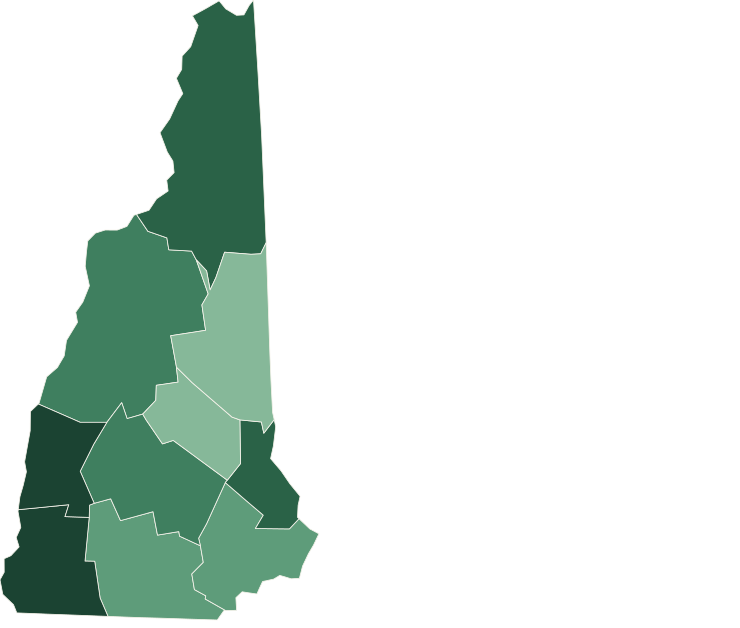
- under 1.58%
- 1.58% to 1.72%
- 1.72% to 1.85%
- 1.85% to 2.14%
- 2.14% and up
| County | Effective rate | Median yearly tax | Median home value |
|---|---|---|---|
| Belknap County | 1.31% | $4,924 | $374,900 |
| Carroll County | 0.99% | $3,848 | $388,900 |
| Cheshire County | 2.16% | $6,048 | $280,100 |
| Coos County | 1.90% | $3,579 | $188,900 |
| Grafton County | 1.72% | $5,925 | $344,500 |
| Hillsborough County | 1.66% | $6,999 | $421,100 |
| Merrimack County | 1.84% | $6,783 | $367,600 |
| Rockingham County | 1.58% | $7,839 | $497,500 |
| Strafford County | 1.85% | $6,708 | $362,800 |
| Sullivan County | 2.14% | $5,756 | $268,700 |
For owner-occupied homes, the figures come from Census American Community Survey 2020 to 2024. Table B25103 covers median taxes paid for real estate, and table B25077 covers median value. Divide the median tax by the median value to calculate the effective rate. Download every county as a CSV file.
Homestead exemption in New Hampshire
Low and Moderate Income Homeowners Property Tax Relief. The state pays relief by check to people who own a homestead. The state education property tax applies, and they must have lived there on April 1. Single people must have a household income of $37,000 or less. For married people and heads of household, the limit is $47,000 or less.
Apply online through Granite Tax Connect, or send Form DP-8 (Claim for Low and Moderate Income Homeowners Property Tax Relief) to the Department of Revenue Administration.
You may file from May 1 through June 30. If an accident, mistake, or misfortune caused a late filing, it may be accepted until November 1.
Source: revenue.nh.gov
Appealing a property tax assessment in New Hampshire
APPEAL BYAbatement application deadline: March 1, except that a Notice of Tax issued after Dec. 31 sets a deadline 2 months later. BTLA appeal: September 1.
Submit a written abatement application to your municipality. If it is denied or no decision is made, appeal to the BTLA or superior court, but not both. Send the BTLA form by mail and pay the required fee. The BTLA does not accept electronic filings.
The first hearing takes place before the municipality (in Manchester, the Board of Assessors). You then have a choice between the state Board of Tax and Land Appeals (BTLA) and superior court, but you cannot use both.
Source information: btla.nh.gov
Due dates for New Hampshire property taxes
Each town sets its own dates. Many towns issue two bills each year, with the first due around July 1 and the final due around December 1. Dover instead uses December 1 and June 1.
Source: ashland.nh.gov
Support for older homeowners in New Hampshire
Each town sets its own rules, and elderly exemptions have different income and asset limits by municipality, so ask your town about them. The Low and Moderate Income Homeowners program is the only statewide relief, and it uses income rather than age.
Source: barrington.nh.gov
New Hampshire exemption for veterans with disabilities
A statewide standard credit of $700 applies to residential property taxes for certain veterans. Eligible groups include veterans with a service-connected disability that is both total and permanent, double amputees, paraplegics, and their unremarried surviving spouses. Towns may increase it, but not beyond $5,000.
From: revenue.nh.gov
Property tax relief for homeowners with disabilities
Homeowners with a disability in Manchester receive a $240,000 reduction in their total assessed value under RSA 72:37-b.
Information from manchesternh.gov, a local office; county rules may differ.
How New Hampshire determines your home's value
Each year, city or town assessors value homes as of April 1 according to what they should sell for in the open market. Oversight of the assessment review process belongs to the state Department of Revenue Administration.
The source is revenue.nh.gov.
Other New Hampshire property tax rules to understand
- Property tax deferral is allowed in Manchester under RSA 72:38-a. Deferred property taxes cannot total more than 85% of the property's assessed value.
- To appeal to the BTLA, you must send a $65 filing fee by check or money order through the mail or hand delivery. The BTLA does not accept credit cards or electronic filings.
- Appeals concerning the amount of Low and Moderate Income relief, or a denial, may go to the Board of Tax and Land Appeals. You have 30 days from the notice date to file.
- A building damaged by fire or a natural disaster during the tax year can have its assessment prorated. Apply to the municipality within 60 days after the event or by March 1, whichever comes later.
Sources for these rules: manchesternh.gov (a local office); btla.nh.gov; revenue.nh.gov.
How New Hampshire compares with other states
Check how the New Hampshire rate ranks among all states in the state property tax rates table, review homestead exemption eligibility in other states, or find the appeal deadline for each state.