
North Carolina property tax calculator
The median yearly amount homeowners pay in North Carolina is $1,896, equal to 0.66% of the median home value, $288,900.
An estimate, not a bill. Your county assessor (an appraisal district in some states) sets your value, and your local taxing units set the rates. Check with your county before paying or protesting.
Typical bill and property tax rate in North Carolina
The North Carolina rate sits below the US figure of 0.94%. County rates across the state range from 0.34% in Jackson County up to 1.15% in Halifax County. All numbers are medians for owner-occupied homes, drawn from the Census American Community Survey 5-year estimates covering 2020 to 2024.
Yearly tax bill for typical home values in North Carolina
| Home value | State median rate, 0.66% | Jackson County, 0.34% | Halifax County, 1.15% |
|---|---|---|---|
| $200,000 | $1,320 | $680 | $2,300 |
| $300,000 | $1,980 | $1,020 | $3,450 |
| $400,000 | $2,640 | $1,360 | $4,600 |
| $500,000 | $3,300 | $1,700 | $5,750 |
Home value multiplied by the effective rate. The lowest county rate in North Carolina belongs to Jackson County and the highest to Halifax County; the calculator applies your own county's rate.
Property tax rates for North Carolina counties
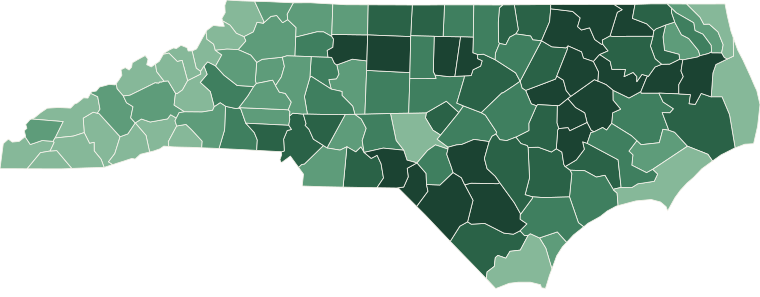
- under 0.54%
- 0.54% to 0.62%
- 0.62% to 0.69%
- 0.69% to 0.79%
- 0.79% and up
The highest rates in North Carolina
| County | Effective rate | Median yearly tax |
|---|---|---|
| Halifax County | 1.15% | $1,216 |
| Northampton County | 1.08% | $1,239 |
| Martin County | 1.06% | $1,168 |
| Edgecombe County | 1.04% | $1,306 |
| Washington County | 0.99% | $1,252 |
The lowest rates in North Carolina
| County | Effective rate | Median yearly tax |
|---|---|---|
| Jackson County | 0.34% | $976 |
| Avery County | 0.38% | $1,010 |
| Watauga County | 0.39% | $1,386 |
| Swain County | 0.41% | $859 |
| Macon County | 0.43% | $1,074 |
The 100 North Carolina counties, A to Z
| County | Effective rate | Median yearly tax | Median home value |
|---|---|---|---|
| Alamance County | 0.62% | $1,494 | $241,500 |
| Alexander County | 0.60% | $1,269 | $211,800 |
| Alleghany County | 0.57% | $1,217 | $214,800 |
| Anson County | 0.77% | $1,141 | $148,600 |
| Ashe County | 0.49% | $1,190 | $243,100 |
| Avery County | 0.38% | $1,010 | $265,800 |
| Beaufort County | 0.68% | $1,300 | $192,700 |
| Bertie County | 0.79% | $778 | $98,500 |
| Bladen County | 0.91% | $1,227 | $135,100 |
| Brunswick County | 0.54% | $1,890 | $349,800 |
| Buncombe County | 0.57% | $2,222 | $391,800 |
| Burke County | 0.68% | $1,253 | $185,400 |
| Cabarrus County | 0.73% | $2,586 | $354,800 |
| Caldwell County | 0.60% | $1,150 | $192,200 |
| Camden County | 0.58% | $1,952 | $337,100 |
| Carteret County | 0.43% | $1,423 | $333,300 |
| Caswell County | 0.69% | $1,140 | $164,500 |
| Catawba County | 0.58% | $1,407 | $241,600 |
| Chatham County | 0.64% | $2,847 | $446,200 |
| Cherokee County | 0.46% | $1,064 | $232,300 |
| Chowan County | 0.71% | $1,677 | $235,800 |
| Clay County | 0.43% | $1,186 | $278,400 |
| Cleveland County | 0.64% | $1,286 | $200,000 |
| Columbus County | 0.77% | $1,120 | $146,000 |
| Craven County | 0.63% | $1,450 | $231,600 |
| Cumberland County | 0.93% | $1,850 | $199,200 |
| Currituck County | 0.47% | $1,760 | $378,800 |
| Dare County | 0.52% | $2,391 | $460,400 |
| Davidson County | 0.60% | $1,320 | $219,100 |
| Davie County | 0.63% | $1,595 | $253,900 |
| Duplin County | 0.69% | $950 | $137,400 |
| Durham County | 0.79% | $3,092 | $389,400 |
| Edgecombe County | 1.04% | $1,306 | $125,100 |
| Forsyth County | 0.79% | $1,984 | $250,400 |
| Franklin County | 0.65% | $1,834 | $284,300 |
| Gaston County | 0.74% | $1,982 | $266,000 |
| Gates County | 0.76% | $1,296 | $170,800 |
| Graham County | 0.57% | $979 | $170,600 |
| Granville County | 0.67% | $1,664 | $247,700 |
| Greene County | 0.89% | $1,041 | $117,400 |
| Guilford County | 0.84% | $2,174 | $259,900 |
| Halifax County | 1.15% | $1,216 | $106,200 |
| Harnett County | 0.69% | $1,689 | $246,200 |
| Haywood County | 0.57% | $1,583 | $279,200 |
| Henderson County | 0.52% | $1,810 | $351,400 |
| Hertford County | 0.98% | $1,168 | $119,200 |
| Hoke County | 0.67% | $1,465 | $219,300 |
| Hyde County | 0.79% | $975 | $124,000 |
| Iredell County | 0.61% | $1,952 | $321,400 |
| Jackson County | 0.34% | $976 | $284,700 |
| Johnston County | 0.62% | $1,908 | $305,600 |
| Jones County | 0.74% | $964 | $130,300 |
| Lee County | 0.74% | $1,785 | $240,200 |
| Lenoir County | 0.84% | $1,015 | $120,500 |
| Lincoln County | 0.58% | $1,856 | $321,000 |
| Macon County | 0.43% | $1,074 | $251,900 |
| Madison County | 0.48% | $1,362 | $284,600 |
| Martin County | 1.06% | $1,168 | $109,700 |
| McDowell County | 0.53% | $911 | $171,100 |
| Mecklenburg County | 0.71% | $2,890 | $406,800 |
| Mitchell County | 0.52% | $1,141 | $220,100 |
| Montgomery County | 0.64% | $1,037 | $161,700 |
| Moore County | 0.53% | $1,849 | $351,400 |
| Nash County | 0.71% | $1,362 | $191,000 |
| New Hanover County | 0.54% | $2,105 | $387,800 |
| Northampton County | 1.08% | $1,239 | $114,500 |
| Onslow County | 0.64% | $1,502 | $236,400 |
| Orange County | 0.91% | $4,162 | $459,500 |
| Pamlico County | 0.56% | $1,218 | $216,800 |
| Pasquotank County | 0.67% | $1,573 | $234,600 |
| Pender County | 0.63% | $1,883 | $299,000 |
| Perquimans County | 0.59% | $1,375 | $231,700 |
| Person County | 0.62% | $1,328 | $213,900 |
| Pitt County | 0.83% | $1,734 | $208,900 |
| Polk County | 0.54% | $1,697 | $315,000 |
| Randolph County | 0.67% | $1,324 | $197,100 |
| Richmond County | 0.89% | $1,138 | $127,800 |
| Robeson County | 0.87% | $820 | $94,500 |
| Rockingham County | 0.75% | $1,258 | $168,600 |
| Rowan County | 0.65% | $1,554 | $238,400 |
| Rutherford County | 0.58% | $1,178 | $201,800 |
| Sampson County | 0.75% | $1,130 | $150,700 |
| Scotland County | 0.93% | $1,068 | $114,900 |
| Stanly County | 0.57% | $1,385 | $242,400 |
| Stokes County | 0.60% | $1,179 | $196,700 |
| Surry County | 0.60% | $1,071 | $177,600 |
| Swain County | 0.41% | $859 | $207,000 |
| Transylvania County | 0.45% | $1,674 | $373,600 |
| Tyrrell County | 0.81% | $1,331 | $164,500 |
| Union County | 0.57% | $2,396 | $417,300 |
| Vance County | 0.78% | $1,256 | $161,500 |
| Wake County | 0.71% | $3,260 | $461,300 |
| Warren County | 0.71% | $1,093 | $154,200 |
| Washington County | 0.99% | $1,252 | $125,900 |
| Watauga County | 0.39% | $1,386 | $358,900 |
| Wayne County | 0.70% | $1,249 | $178,700 |
| Wilkes County | 0.59% | $1,002 | $168,800 |
| Wilson County | 0.79% | $1,471 | $186,000 |
| Yadkin County | 0.67% | $1,220 | $181,200 |
| Yancey County | 0.48% | $1,157 | $243,100 |
For owner-occupied homes, median real estate taxes paid come from table B25103 and median value from table B25077, Census American Community Survey 2020 to 2024. Median tax divided by median value gives the effective rate. Download CSV for every county.
Homestead exemption in North Carolina
Elderly or Disabled Exclusion, under G.S. 105-277.1). The exclusion applies statewide to owners aged 65 or older, or owners who are totally and permanently disabled, who meet the $37,900 income limit in the 2025 tax year. The excluded value is whichever is greater: the first $25,000 of the home's appraised value or 50% of that value.
How to apply: the filing goes to the county tax assessor where the property sits, using Form AV-9, not to the state Department of Revenue.
Deadline for filing: June 1.
Source details: ncdor.gov
How to appeal a property tax assessment in North Carolina
APPEAL BYFor the Property Tax Commission appeal, file within 30 days, counting from when the local board mails its decision
Contact the county tax office informally first. Then appeal the value to the Board of Equalization and Review in your county, which begins meeting from about early April. You must file another appeal with the state Property Tax Commission within 30 days of the board mailing its decision.
The first hearing is held by the County Board of Equalization and Review.
Source: ncdor.gov
Due dates for North Carolina property taxes
Statewide, the payment date for property taxes is September 1, in the fiscal year in which they are levied. Payment at face value is allowed before January 6. Interest charges then apply once payments are made on or after January 6.
The source is ncleg.gov.
Help for older homeowners in North Carolina
Statewide, the Elderly or Disabled Exclusion exempts whichever amount is larger: the first $25,000 of a home's appraised value, or 50% of that value. It applies to owners who are totally and permanently disabled, or who have reached 65, whose 2026 income is $38,800 or less. Submit your filing to the county assessor by June 1.
The source is ncdor.gov.
North Carolina's disabled veteran exemption
Statewide, a disabled veteran's permanent residence is exempt from tax on the first $45,000 of its appraised value. The veteran needs an honorable or under honorable discharge plus either specially adapted housing benefits or a disability that is total, permanent, and service-connected. An unremarried surviving spouse also qualifies. There is no limit on age or income.
The source is ncdor.gov.
Help for homeowners who have a disability
The homestead exemption is one you can qualify for at any age if you are a homeowner who is totally and permanently disabled. They must submit a certification of disability from a North Carolina-licensed physician, and they must also meet the income limit of $38,800 that applies for 2025.
The source is dconc.gov.
How your home is valued in North Carolina
Under state law, each county must reappraise real property at least once every eight years, and some counties reappraise every four years. County assessors are the ones who set the values, and apart from reappraisals they may adjust values only in limited circumstances.
Source link: ncdor.gov
Other North Carolina property tax rules to know
- The Circuit Breaker deferment limits annual taxes to 4% of income where 2025 income is $38,800 or less (a 5% limit for higher incomes listed in the stated range). Amounts above the cap are deferred, and a fresh application is needed every year.
- Late relief applications are accepted by Wake County after the June 1 deadline, up to the end of 2026. Accepted reasons include a death, military deployment, hospitalization, or illness, and each request is reviewed individually.
- Long-term homeowners with low incomes may be able to receive added help through the Department of Social Services in the county, which runs the Low-Income Homeowners Relief (LIHR) program.
Compare North Carolina to other states
The state property tax rates table shows where the North Carolina rate ranks among all states. You can also check homestead exemption eligibility elsewhere and look up each state's appeal deadline.